ROCKET SCIENCE IS FOR EVERYONE
The year was 1969. I was a child of 6, just hitting that golden age where curiosity, awareness, knowledge and understanding all seem to start to come together, but before school starts to beat it out of you. NASA was about to succeed in, as President Kennedy said, “landing a man on the Moon and returning him safely to the Earth”. I missed the speech by a couple of years, but I was there for the payoff. It’s a whole lot of years later, and laying on the floor in our living room watching the Apollo missions on TV is still one of the clearest, most vibrant memories I have. I remember getting a poster—actually I think it was probably really a placemat—of the Apollo 11 astronauts at a Jerry’s restaurant. I had that picture on my wall for a long time. Much has changed. Can you imagine a six year old kid getting a picture of three astronauts (or any other real-life, non-sports people) at a restaurant and being thrilled by it today? Neil Armstrong, Buzz Aldrin and Michael Collins were heroes to me. It was a grand time to be a kid in America. At least it was for me, fortunate as I was.
Anyway, I’ve been thinking about those days lately, for some reason. Part of it is probably just nostalgia and part of it is probably related to the anti-science environment that seems to permeate much of modern life. That, coupled with a couple of news articles I’ve read lately gave me the inspiration for this column. NASA has had a string of hits with the Mars rovers, The Kepler probe, the James Webb Space Telescope, Artemis I and a number of others, along with some hiccups, like the Starliner failure at the ISS (which was actually more of a Boeing problem). Despite all the amazing science from the probes, Hubble and the JWST (and there has been A LOT), I’ve been a little sad that NASA has been running kind of under the radar with manned space flight since the last shuttle flight in 2011. It’s hard to believe that it’s been almost 14 years since the last shuttle flight. We’ve been up and down to the International Space Station a number of times, but those trips were mostly on SpaceX rockets, and those low-orbital missions just don’t capture the imagination the way the Apollo missions did.
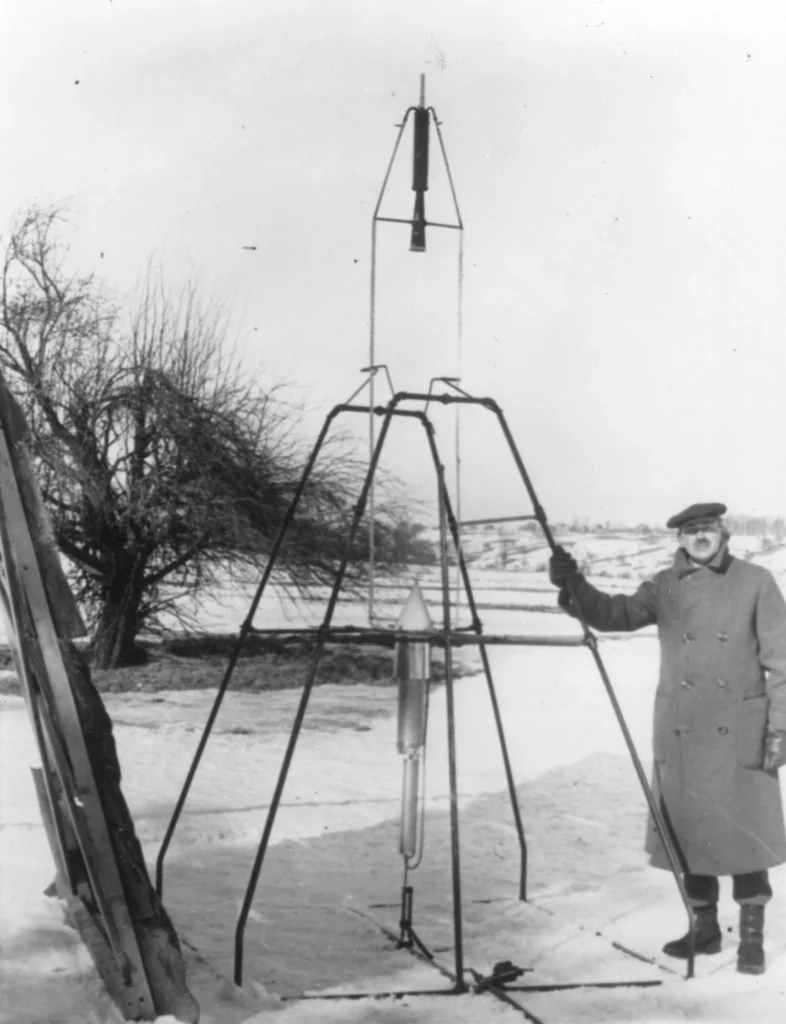
Robert Goddard and his rocket, 1926. Credit: NASA
I was raised on the Apollo missions to the Moon, and I can remember how proud and thrilled I was when the Space Shuttle first flew in 1981. I also remember how devastated I was when the Challenger blew up in 1986. That was, unbelievably, almost 40 years ago. All in all, there were 135 shuttle flights. Shuttle flights became almost mundane. It was easy, after watching so many launches, to get complacent and forget about what a magnificent achievement the space shuttles were. No other nation on Earth could have done it. I doubt any other nation could do it, even today, and we started research and development on the program in 1972—53 years ago. There is something about space flight, particularly manned space flight, that is particularly inspiring. Some of that is probably because I think people have a very deep, very ancient connection with the cosmos. We’ve been wondering about and dreaming about the stars since the first time our ancestors looked up at the night sky. Part of it is the adventure of it. Part of it is the sheer audacity of making the attempt to leave the Earth. Whatever it is, the lure of spaceflight endures. Many a kid became a scientist or engineer because of the space program.
But, this article is about rockets, so let’s get on with the rocket science! Well, let’s get on with that in a minute. Let’s talk about the term “rocket science”, first. That term has been used to describe really difficult-to-understand things, or really smart people (rocket scientists) since back in the early days of space flight, back in the 50’s. Although it makes its point, the science of rockets is really pretty simple, for the most part. The basic theory behind rocket science has been understood for over 300 years, when Isaac Newton came up with his Laws of Motion. It is specifically the Third Law that applies to rockets—a simple way of stating it is “for every force applied in one direction, there is an equal force applied in the opposite direction”. That is why rockets work. If you have ever had one of those little rockets you fill up with water and then pump air into before you let it go and it shoots into the air (loved those as a kid!), you have used a rocket. So, “rocket science” isn’t all that big a deal, fundamentally. A 10 cent bottle rocket is, technically, a rocket. “Rocket engineering”, however, is another matter entirely. Engineering a machine that can lift hundreds of thousands of pounds of mass and accelerate it to a high enough speed (about 40,000 kilometers/hour or 25,000 miles/hour) that it can escape the Earth’s gravity is a very big deal, indeed.
Given that the idea of a rocket is, essentially, pretty straightforward, it shouldn’t be all that surprising that the first rockets were invented a long time ago. Actually, it was a very long time–about 800 years ago in China. They used gunpowder as a fuel, much like the bottle rockets of today. The plans for the first controllable, liquid-fueled rocket were developed by Robert Goddard in 1912, and the first one actually flew in 1926. It is amazing how little rockets have changed. The solid-fuel rockets that boosted the space shuttle into orbit are really not very different from the gunpowder-fueled rockets of 13th century China. The liquid-fueled rocket engines of the space shuttle orbiter, and those of the SpaceX Falcon and the NASA Space Launch System (SLS) are not much different from the engines of WWII V-2 rockets, or Goddard’s early rockets, for that matter. What is different is size, power, reliability, safety, controllability, and efficiency. Early Chinese gunpowder rockets generated probably only a few pounds of thrust. The solid fuel rocket boosters of the SLS generate over 3.6 million pounds of thrust (each), even more than the space shuttle boosters, which generated over 3 million pounds of thrust. The liquid-fueled engines of the Saturn V rockets that powered the Apollo missions generated about 1.5 million pounds of thrust each. The first stage of the Saturn V had 5 engines, so the total thrust was over 7.5 million pounds of thrust.
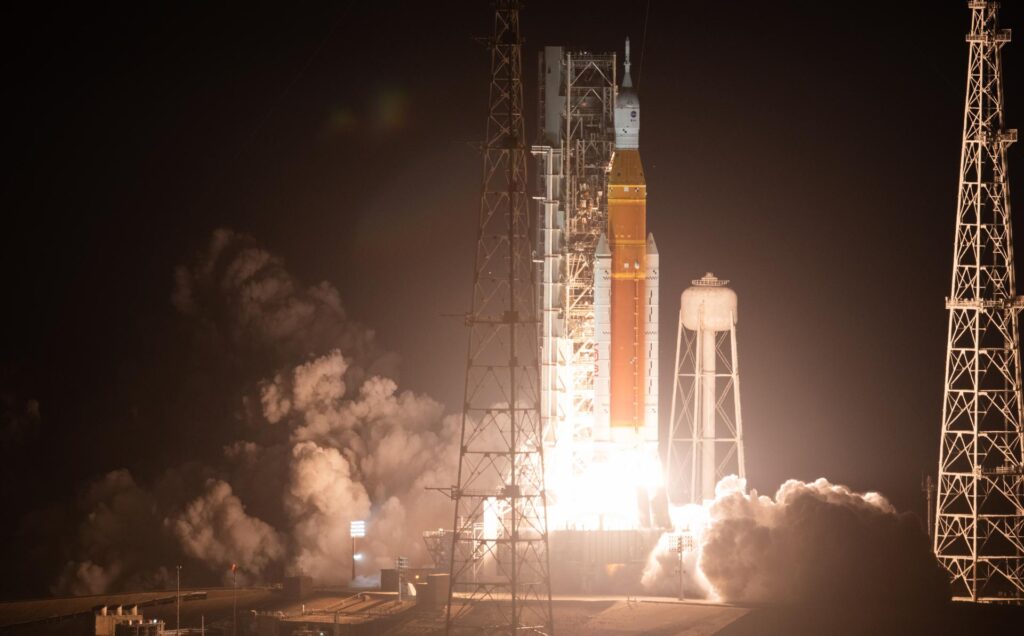
Space Launch System (SLS). Credit: NASA
What is all this about thrust, you ask? “Thrust” is the amount of power generated by the engine, and it is what makes rockets move. Let’s get back to Newton’s Third Law. For every action (shooting something out one end of a rocket), there is an equal and opposite reaction (the rocket goes up). If you shoot a mass out the back of a rocket at some given thrust, it will push in the opposite direction just as much. So, a rocket engine with 1 million pounds of thrust pushes on the rocket to lift it with 1 million pounds of force. Equal force, opposite direction. With the little water/air rocket we were discussing before, the “thing” that gets shot out of the rocket is water. What shoots the water out is the compressed air you pumped into it. When the water goes out in one direction, the rocket moves in the other. Most of the time in “real” rockets, what gets shot out of the back is a gas. How much gas and how fast it moves is what determines the thrust. That’s why a rocket launch is such a dramatic and awesome thing to watch. Lots of flame and noise.
The gasses are generated by combustion of a fuel. As we all know from previous articles, combustion is a form of oxidation, meaning that the fuel combines with oxygen to release energy. In a rocket, lots of fuel combines with lots of oxygen very quickly to produce a huge volume of exhaust gasses expanding at incredible pressure. If you burn 10,000 pounds of fuel, it will generate probably 50,000 pounds of exhaust gasses (as the mass of the fuel combines with the mass of the oxygen). All that gas is produced very fast, so the pressure is very high. If the pressure is very high, the gasses will move very fast as they shoot out the back of the rocket. A large mass of gas, moving very fast, has a lot of kinetic energy. Isn’t it interesting how the subjects of previous articles just keep coming up again? Anyway, all that energy being ejected from the rocket in one direction pushes the rocket to move in the other direction. Rockets generally carry their own supply of oxygen, partly because they use a lot of oxygen very fast to create all that thrust and the oxygen in the air isn’t enough. Another reason is that most rockets are meant to fly either very high where the air is thin or all the way into space, where there is no air at all. Liquid-fueled rockets carry liquid oxygen with them to mix with the liquid fuel, which is usually something like high-grade kerosene, although it can also be a more specialized fuel that releases even more energy when it burns than kerosene does. The Space Shuttle main engines used liquid hydrogen. The good thing about liquid-fueled rockets is that they can be controlled. You can increase or decrease the thrust or turn the rocket on or off and back again. The big down sides of liquid-fueled rockets is that they are incredibly complicated and the fuel and oxygen aren’t stable for very long. The fuel and oxygen have to be loaded into the rocket shortly before takeoff. There are all kinds of pumps and pipes and valves that have to work perfectly to mix the right amounts of oxygen and fuel, all at very high pressures and very high speeds, in the very unforgiving environment of the inside of a rocket engine, which is essentially a barely controlled explosion. That is why the engineering is so complicated.
Solid-fuel rockets have benefits and downsides. The big benefit is that they are very, very much simpler. A solid-fuel rocket is, more or less, a very large amount of explosive packed into a tube that is open at the bottom. You ignite the fuel/oxidizer mixture and it burns until it is gone, producing a great deal of thrust as it burns. Most solid rocket fuel is a mixture of a metal (like magnesium or aluminum that burns very hot) as a fuel , an oxidizer (some chemical with lots of oxygen in it), and some other things to hold it together and make it stable. Most ICBM (intercontinental ballistic missiles) are solid-fuel rockets, because they can just sit in a silo for years, ready to go because the fuel/oxidizer mix is stable, and then be fired at a moment’s notice. The big downside of solid-fuel rockets is that most of them, once ignited, will just fire until they run out of fuel. The thrust can’t be increased or decreased and they can’t be shut down and reignited later. Some very advanced solid-fuel rockets can be controlled, but they tend to be much less efficient and much more expensive.
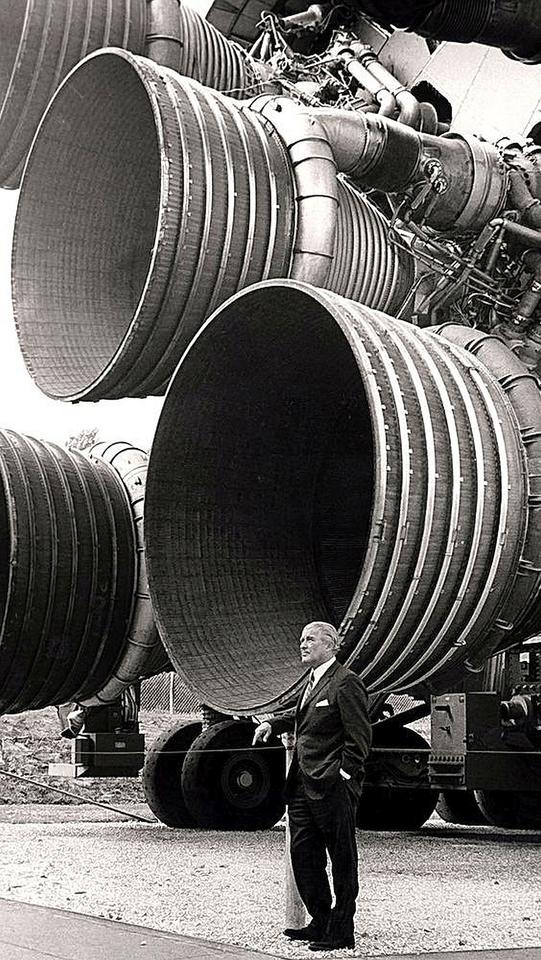
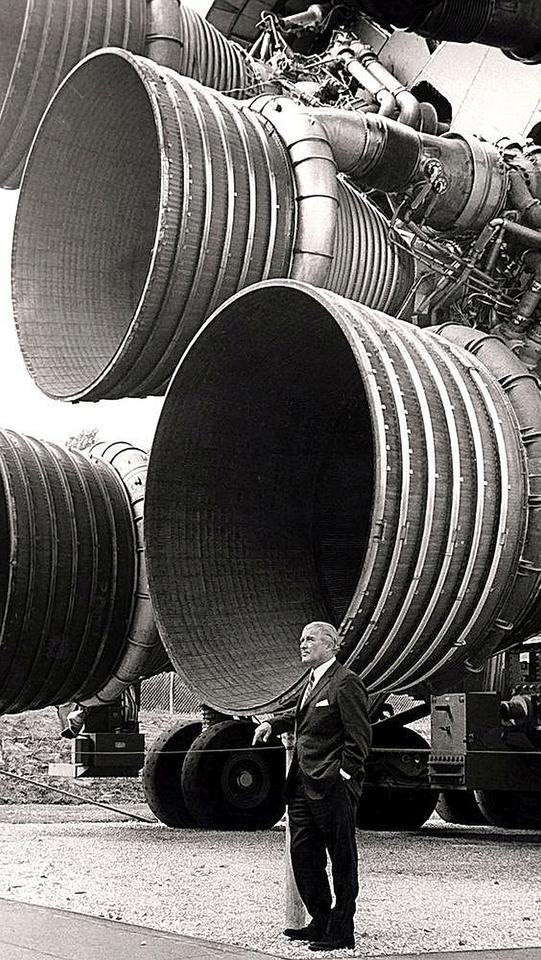
Werner von Braun next to the first stage of the Saturn V, showing the five F-1 engines. Credit: NASA
If you are interested in this sort of thing, I highly suggest a trip down to the US Space and Rocket Center in Huntsville, Alabama. The place is Valhalla for rocket nerds—all kinds of fantastic space-flight-related exhibits. I first went there as a kid. They had a Saturn V rocket on display, lying on its side. Absolutely gargantuan. It’s really impossible to imagine it unless you see it. However, rockets aren’t meant to sit outside in the Alabama weather for years. They were designed to be shot into space shortly after being built, to either burn up in the atmosphere on re-entry or fail into the ocean. For instance, the first stages of the Saturn V only burned for about 2 ½ minutes, consuming almost 2500 tons of propellant, pushing the rocket to an altitude of about 40 miles. When they were expended, they fell back into the Atlantic Ocean. Because of this expected short life, they weren’t really built to sit in the rain for years. Anyway, the Saturn V I saw as a kid is still there, but it’s now in a building designed to protect it and show it off. The rocket is fully restored, and it is magnificent. They also have a replica Saturn V standing upright outside, just so you can see what a 365-foot-tall rocket looks like.
One final geeky thing: if you are old enough to remember what those massive rocket engines (not the whole rocket, just the engine) looked like, you might recall that the nozzles that the flames shot out of looked sort of like they were made of wicker. Metal, of course, but sort of a bunch of rings stacked together to make the cone. The reason for this is one of the many incredibly ingenious design features of those engines. As you can imagine, when the rockets fire, they generate not just thrust, but an amazing amount of heat—so much so that the nozzles would tend to melt. The solution was to run the very cold propellant through tubes that were formed together to make the nozzles. The fuel running through the lines cooled the nozzles and the flames heated the fuel, making combustion more efficient. How cool is that? Can you imagine sitting around back in the sixties, trying to figure out how to make a rocket engine that big that wouldn’t melt itself, and coming up with an idea that elegant?
Next time you see a bottle rocket shoot up on the Fourth of July, you will know that what you are actually watching is, at its core, a process that has been mostly unchanged for over 800 years. It is a perfect demonstration of Newton’s Third Law of Motion. Even better than that, you will also know that the bottle rocket is fundamentally the same as the solid-fuel boosters that sent the space shuttle into orbit and the SLS to the Moon. Watching the bottle rocket is fun. Knowing why the bottle rocket goes up makes it more fun. Knowing that the bottle rocket and the SRB on the space shuttle are basically the same, except for a “few” details, is even better.
Now you know rocket science. How about that? Not such a big deal, after all.